
How to Focus on Landing Page Content that Converts

When most people hear Conversion Centered Design, it’s common that their first thoughts go towards layout, imagery, design psychology and the hierarchy of your landing page’s copy.

However, what most often gets overlooked is whether the copy on the page that is optimized for conversion as well.

X tips on landing page content that converts

Create clear rather than clever landing page copy

As with most campaigns, you want your campaign to stand out and avoid being sterile and lifeless.  Yet, often in the race to be witty, landing page copy can become obtuse and generic, creating confusion for visitors and accidentally replacing your Value Proposition with superlative jargon.

This doesn’t mean your copy needs have the spirit of a toaster manual, it simply means that the key elements in your content’s conversion hierarchy should make it as easy as possible for a visitor to determine the unique value and campaign proposition you’re providing.
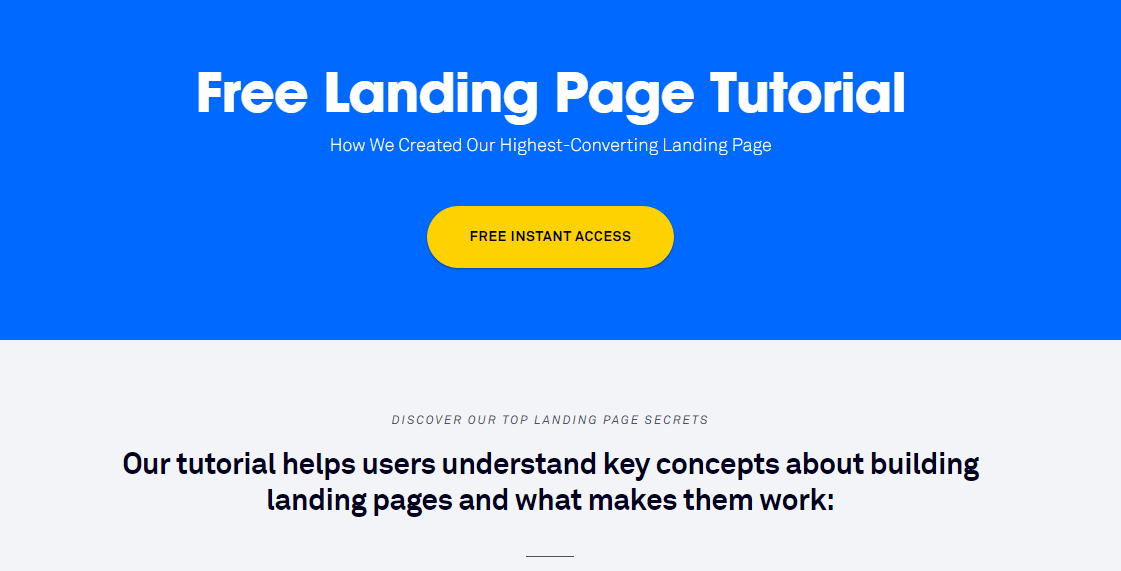
 

landing page copy example 1

The above example is clear in what it is offering (free landing page tutorial) and the value the product provides (helps users understand key concepts about building a landing page).

Unbounce Dejargonator Chrome Extension

If you’re looking for a quick scan of superlatives and jargon, Unbounce has created a Chrome extension called the Dejargonator designed to identify fluffy copy that’s worth installing.
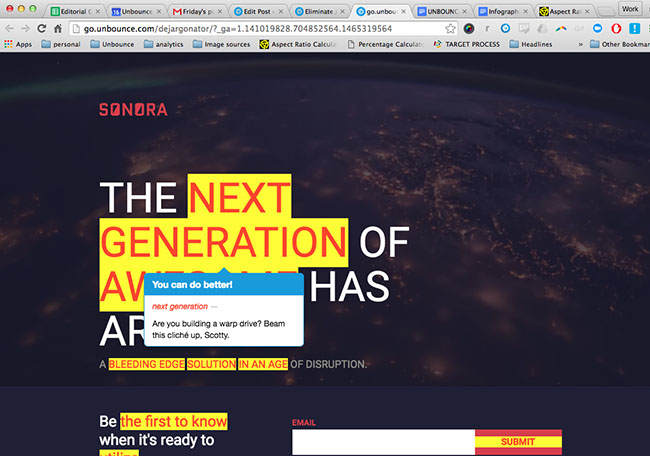
Unbounce Dejargonator

5 Second User Test Your Landing Page

Once you have your landing page content to converting level of clarity, it’s worth investing time to see how clear it is to potential users.  When you know your company, your products and services and the goals behind your campaigns, it’s hard to be objective when reviewing whether your landing page copy is clear.

Tools like Usability Hub allow you to create 5 Second User Tests to bring objective data to determine if users can quickly determine things like:

  • What does your product do?
  • How much is your service?
  • What is that you’re offering them?

Quick feedback like this can offer real data on whether your campaign’s landing page copy is clearly communicating critical information or not.

A/B Test Which Landing Page Content Converts
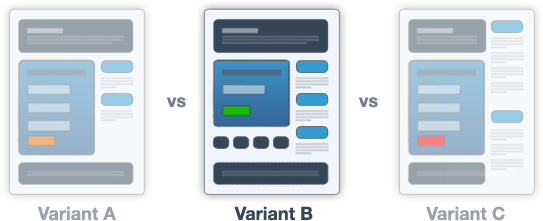
ab testing landing page copy to convert

Landing page copywriting shouldn’t be “set and forget”.  While a starting foundation is important, iterating on that foundation is critical.


The important part with creating landing page copy that converts is to make it a major part of your conversion optimization plan.

Want to learn more about making clear landing page content?  Unbounce has a great examination of how increase conversions by using clarity in your landing page copy.

The Agency & Client Relationship

Hiring an agency is often a difficult task as many companies claim to bring you all the conversions you want despite providing a clear plan to do so. I say that hypocritically as we have that phrase prominently featured on our homepage. It is difficult for many companies or marketing teams to stay on top of the digital trends, so naturally they seek out agencies to help them. It’s a win-win situation, agencies get a client where as clients get the assistance they need. It is all about transparency though, which is something we ensure every client receives Here are some things to consider on both sides of the fence when entering into a new relationship and how to make your expectations very clear from the start.

The Beginning

Both parties should agree on the goals and success metrics up front. Sometimes it’s even beneficial to have these metrics as an addendum to the initial contract. There will be metrics that are quantifiable and those that are not, but both parties need to understand what defines success of the agreement they are engaging in. Here are some quantifiable metrics to consider:

  • X% Increase in organic search traffic & conversion
  • X% Increase in overall website conversion
  • X% Decrease in overall website bounce rate

The Honeymoon is Over

Clients, please give the agencies enough time to implement their strategies. Agencies, please understand that clients need to see results. Never the less, after the initial excitement of starting a new campaign or strategy there will be things that work, some that don’t, and new ideas presented. You must work together as a team to overcome these issues and make tweaks to the initial strategies. Short leashes don’t work for college football coaches and they sure don’t work for digital marketing partnerships.

Black, White & Grey

Web analytics will tell both parties a lot about the effectiveness of campaigns. While the numbers are pretty black and white there will always be grey areas where a conversation regarding the strategy must take place. For instance, Social Media traffic may have an abysmal bounce rate and terrible conversion rate. However, this could be due to the targeting, the creative, the landing page, and a myriad of other issues. It should be the responsibility of the agency to point these things out, but again, this is a team effort and we must work together for our common goals.

A Few Reminders

Hey Agencies…

  • It’s not your client’s fault that they don’t know the proper calls to action or creatives to show
  • Your client needs direction in what content to write and what keywords to target, not just a big list of terms
  • It is your responsibility to be your client’s eyes and ears, so continue to bring new ideas & strategies to the table

Hey Clients…

  • Agencies are an extension of your team, so please keep them in the loop (eg: Product launches, organizational changes, etc)
  • Are you unhappy with the current strategy direction? Work together to change it by discussing your concerns with the agency
  • Do you need help implementing those recommendations? Just ask, because not implementing those recommendations hurts everyone’s chance at success

There are so many things to consider, but at the end of the day it is transparency. Agencies should not be hiding keywords, costs, nor strategies behind some curtain. It is important that you both consider this a partnership and that everyone is on the same team with the same goals in mind!

Redirects: The difference between 301, 302s and Canonical tags

When should I use a 301 redirect, a 302 redirect or a canonical tag?  Don’t they do the exact same thing?

If you work even remotely close to SEO, you’ve heard these questions in one form or the other multiple times.

The short-answers:

  1. Are 301s, 302s and canonicals the same thing? No.
  2. When should I use 301 redirects? Whenever you’re permanently moving content to a new domain or URL, have multiple paths to the same page or when merging two sites together.
  3. When should I use 302 redirects? Rarely.  Commonly used whenever an unexpected or limited time event requires redirecting traffic from a URL to a new URL temporarily.
  4. When should I use Canonical tagsWhen you have duplicate pages and want to tell a search bot what page you’d prefer they display in results.

The long-answer:

While I could spend time reinventing the wheel, Moz put together a fantastic whiteboard post titled “Aren’t 301s, 302s, and Canonicals All Basically the Same?” that covers the long-form answers to this question.


Content is King, and Queen, and Prince…

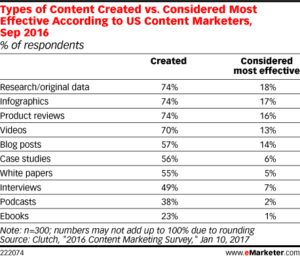
types of digital contentAl Gore created the internet to distribute content to all (*Disclaimer, Al Gore did not create the internet). Too often we see websites with too much or too little content and no clear strategy about what content they should have. An eMarketer article recently noted that many organizations are just pushing out content with no clear strategy, as evidenced by the chart on the right. We believe in data-backed decision making and content decisions are no different. Below are a few quick things that you could do next week in a white board session to make sure you’re presenting the right content to the right audience.

How to determine the right content for your website

  • What is it ya do here? : Develop 5-10 competitive advantages & business goals. Involve EVERYONE; Sales, Upper Management, R&D…
  • Who are your customers? : Develop about 5 target personas. What are their needs & wants? What do they do an a day-to-day basis online. Are they heavy social users? Are they mostly offline?
  • Does your marketing match their needs? : Too often upper management forces messages or tactics on marketing departments. Take the time to review all of your marketing messages and see if they align with your goals as well as the customers.
  • How do you deliver messages? : Evaluate the tactics you’re using and match them up with what you developed in bullet number two. Are there gaps and areas you might be missing?
  • Are you delivering the right content? : Now back to that eMarketer article! If you’ve followed the steps above you should have a perfect guide for what you do, who to target, how to target them, and what to say to them. Now you need to evaluate the types of content you have on your site. Does it match customer expectations?
  • A few content type case studies;

    PROBLEM: We once worked with a hospital who provided Harvard-level explanations on how they treated patients however their target audience were parents who leaned more towards having a high school education.
    SOLUTION: We developed a shortened version that cut the content down by more than 75% and then provided links to the more in-depth sections for visitors to learn even more.

    PROBLEM: One of our clients featured lengthy thought-leadership content when their audience targets were mostly ‘people on the go’ with little time to read.
    SOLUTION: We helped them to develop infographics that showed their expertise on the subject matter but displayed it in bite-sized pieces so it was easily scannable.

    PROBLEM: An upper-level manager forced the marketing team to take up a large amount of homepage real estate for logos of media sites that had mentioned the brand in the past. After talking with customers they told us these logos were either not seen nor useful in their purchase decision.
    SOLUTION: We removed the logos which brought the Calls to Action front and center. Conversion subsequently increased!

    In conclusion…

    Follow the steps we bulleted above to make sure you’re delivering the content experience that meets your business goals but also matches your customers’ expectations. Give visitors what they want and conversion will climb higher and higher!